23 September 2026
3D Printing: Turning Digital Ideas into Physical Reality
3D printing has evolved from a specialized industrial technology into one of the most accessible and versatile manufacturing tools available today. From a small desktop machine, creators can transform digital concepts into functional objects, decorative pieces, prototypes and personalized products—often within a matter of hours.
This ability to move directly from imagination to production is changing the way designers, businesses and independent makers create.
How Does 3D Printing Work?
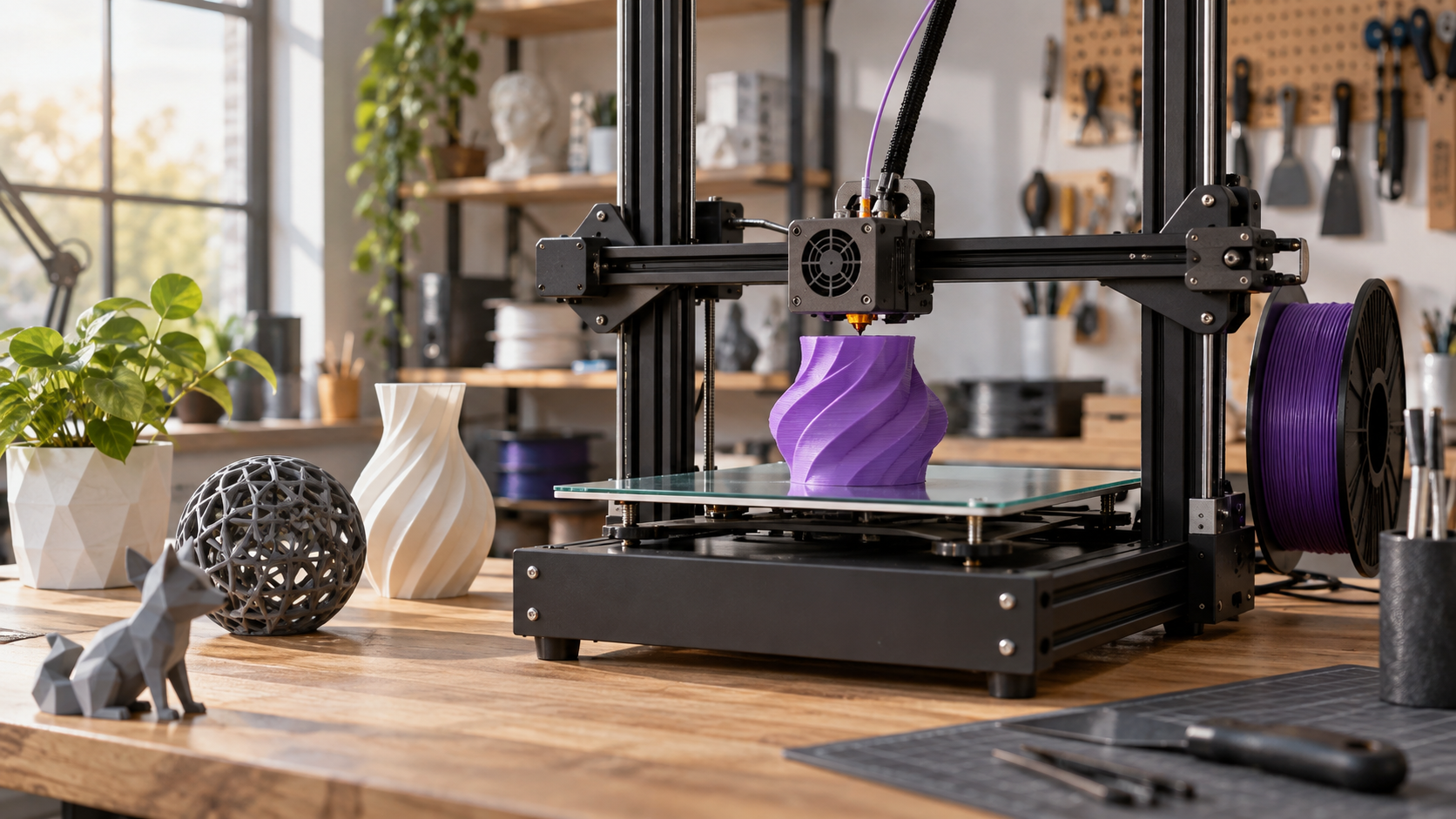
Most desktop 3D printers use a process called Fused Deposition Modeling, commonly known as FDM. The printer heats a thermoplastic filament and deposits it layer by layer onto a build plate. Each layer follows the geometry of a digital 3D model until the complete object is formed.
Materials such as PLA, PETG, ABS and TPU allow creators to produce objects with different levels of strength, flexibility, heat resistance and visual finish.
PLA is particularly popular because it is easy to print, available in a huge variety of colors and suitable for decorative models, miniatures, toys and prototypes. PETG provides greater durability and moisture resistance, while TPU can be used to produce flexible parts.
From Digital Model to Finished Product
Every 3D-printed object begins with a digital model. This model can be designed using CAD or sculpting software, downloaded from a digital marketplace or generated from a 3D scan.
Before printing, the model is processed using slicing software. The slicer divides the object into hundreds or thousands of individual layers and generates the instructions that control the printer.
At this stage, the creator can define important settings such as:
Layer height and surface quality Printing speed Wall thickness Internal structure or infill Material temperature Supports and build-plate adhesion
Finding the right balance between these settings is essential. A highly detailed miniature may require thin layers and slower movement, while a functional component may benefit from thicker walls and a stronger internal structure.
Why 3D Printing Is So Powerful
One of the greatest advantages of 3D printing is design freedom. Traditional manufacturing methods often require expensive molds, specialized machinery or large production quantities. With 3D printing, a single personalized item can be produced without setting up an entire production line.
This makes the technology especially valuable for:
Rapid prototyping Personalized gifts Architectural models Educational tools Replacement components Miniatures and collectibles Medical and accessibility solutions Small-scale product manufacturing
Designs can also be improved quickly. If the first version does not work perfectly, the digital model can be modified and printed again. This rapid cycle of testing and refinement encourages experimentation and reduces the cost of product development.
Designing for Better Prints
A successful 3D model is not only visually attractive—it must also be printable.
Good models use stable contact points, controlled overhangs and carefully planned geometry. Whenever possible, designers should reduce the need for support structures, as supports consume additional material and can leave marks on the finished surface.
For miniatures and decorative figures, details must be strong enough to survive printing and handling. Thin fingers, fragile accessories and unsupported elements may look impressive on screen but can become weak points in the physical model.
Designing specifically for FDM printing creates stronger objects, cleaner surfaces and more reliable production.
The Future of Making
3D printing is becoming faster, smarter and easier to use. Modern machines can automatically calibrate the build plate, monitor material flow and detect printing problems. Multicolor and multi-material systems are also making it possible to produce increasingly complex objects with minimal manual intervention.
However, the real power of the technology is not found only in the machine. It comes from the combination of imagination, digital design and practical understanding.
3D printing gives independent creators the ability to develop products that would once have required an entire factory. It transforms experimentation into production and allows every object to tell a more personal story.
The future of manufacturing will not be defined exclusively by mass production. It will also be shaped by small studios, creative workshops and individual makers capable of transforming unique ideas into physical reality—one layer at a time.